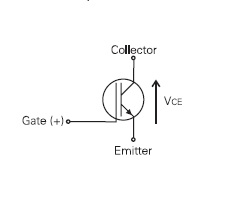
IGBTs (insulated gate bipolar transistor) provide a high
switching speed necessary for PWM inverter operation. IGBTs
are capable of switching on and off several thousand times a
second. An IGBT can turn on in less than 400 nanoseconds
and off in approximately 500 nanoseconds. An IGBT consists
of a gate, collector and an emitter. When a positive voltage
(typically +15 VDC) is applied to the gate the IGBT will turn on.
This is similar to closing a switch. Current will flow between
the collector and emitter. An IGBT is turned off by removing the
positive voltage from the gate. During the off state the IGBT
gate voltage is normally held at a small negative voltage (-15
VDC) to prevent the device from turning on.

switching speed necessary for PWM inverter operation. IGBTs
are capable of switching on and off several thousand times a
second. An IGBT can turn on in less than 400 nanoseconds
and off in approximately 500 nanoseconds. An IGBT consists
of a gate, collector and an emitter. When a positive voltage
(typically +15 VDC) is applied to the gate the IGBT will turn on.
This is similar to closing a switch. Current will flow between
the collector and emitter. An IGBT is turned off by removing the
positive voltage from the gate. During the off state the IGBT
gate voltage is normally held at a small negative voltage (-15
VDC) to prevent the device from turning on.